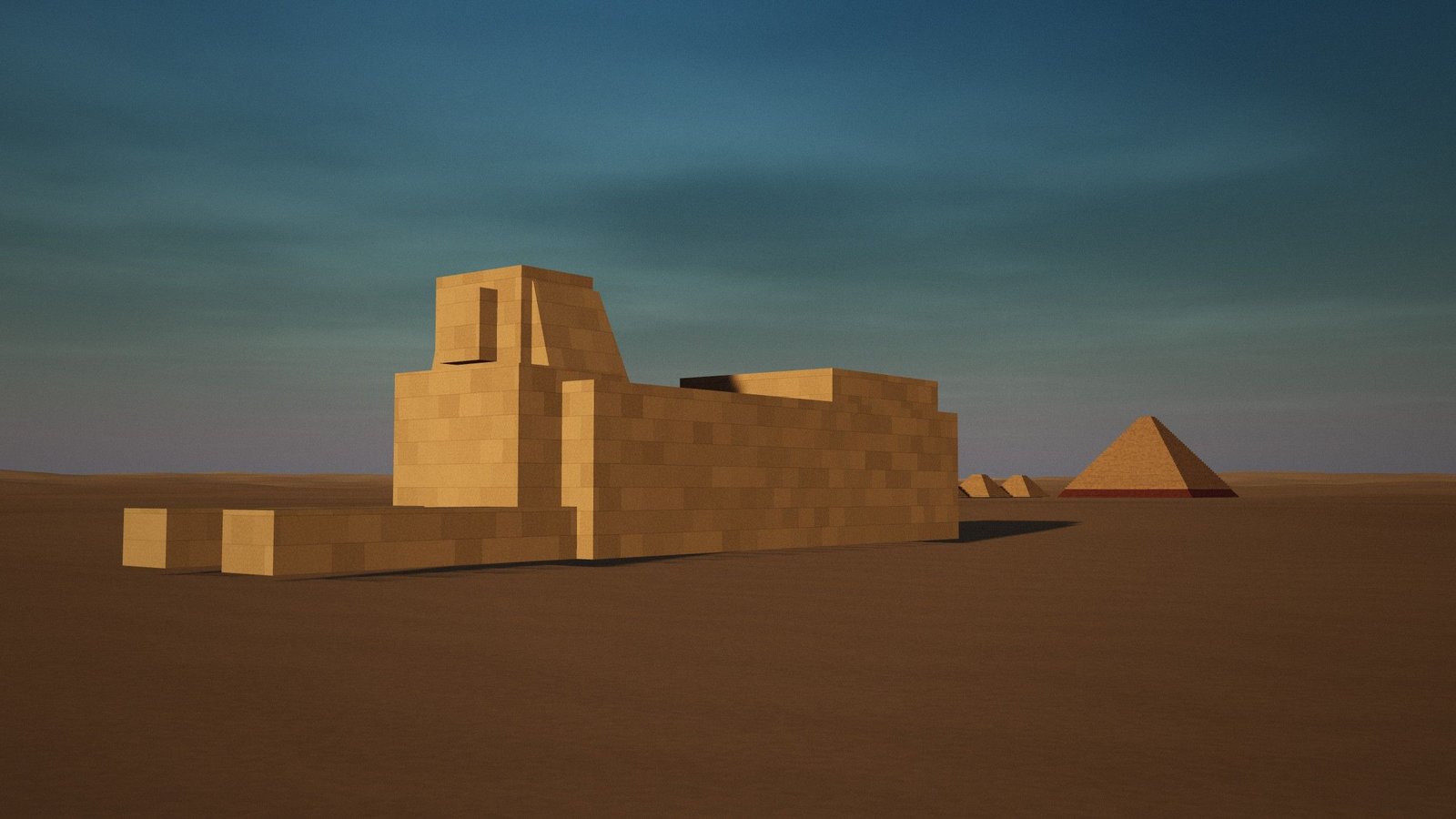
Simplified 3D massing model of the Great Sphinx lying on the plateau, with the pyramid of Menkaure and its queens' pyramids in the distance.
Interpretive 3D model · NeoKemetAI schematic 3D model
Monument · sphinx

Great Sphinx of Giza

Giza Plateau

The Great Sphinx is among the oldest known monumental sculptures in Egypt: a recumbent lion with the head of a king, about 73 m long and 20 m high, carved from the limestone of the Giza Plateau. It lies beside the valley temple of Khafre, at the foot of the causeway that leads up to his pyramid, and faces east.

Most Egyptologists attribute it to Khafre’s reign, around 2500 BCE, from its position in his pyramid complex and the way its enclosure and temple were cut; other attributions are set out below. In the New Kingdom it was worshipped as Horemakhet, “Horus in the Horizon”, and Thutmose IV set up the Dream Stela between its paws after clearing it of sand.

Source note: dimensions and attribution follow the Wikipedia article “Great Sphinx of Giza”; Horemakhet and the restoration history follow ARCE and Z. Hawass. Full references, grouped by how each was used, are at the end of the page.
The monument

Form and dimensions

A lion's body with a king's head, carved from the rock of the plateau and facing east.

The Great Sphinx in profileSide view of the Sphinx, about 73 m long and 20 m high, facing east. The body is carved from three layers of limestone: a hard lower layer, softer and more weathered middle layers forming most of the body, and better-quality stone in the head. The nose and beard are missing; the Dream Stela of Thutmose IV stands between the forepaws.about 73 m, paws to tailabout 20 mNose deliberately removedrod or chisel marks; missing before 1737Beard (fragments; some in the British Museum)Dream Stela of Thutmose IVMember III: head, better stoneMember II: body, soft and hard layers, most weatheredMember I: hard baseWestEast →
Reconstruction note: the profile is schematic and drawn by us, not traced from a survey; only the overall length and height (Wikipedia, "Great Sphinx of Giza") are to scale. The heights of the three rock members and the bedding lines are indicative, after the member sequence described by AERA (Lehner, after Gauri's geological study). Nose tool marks and "missing before 1737" follow Wikipedia's summary of Lehner and of Norden's drawings. Restoration masonry around the body is not shown.
Length
about 73 m from the paws to the tail
Height
about 20 m from the base to the top of the head
Width
about 19 m at the rear haunches
Material
the bedrock limestone of the plateau (the Mokattam Formation), in three members, with masonry added in later repairs
Faces
east
Usual attribution
Khafre (4th Dynasty, reigned c. 2558–2532 BCE); other attributions are set out below

Dimensions and attribution: Wikipedia, Great Sphinx of Giza; material: AERA. The head wears the royal nemes headdress. Traces of red pigment survive on the face, with traces of yellow and blue elsewhere, so the monument was probably once painted. Wikipedia, Great Sphinx of Giza

Carving and context

Cut from the bedrock, beside Khafre's temple

The Sphinx was not built but carved from the bedrock of the plateau. The Sphinx Temple in front of it was built from stone cut from around the Sphinx, and it lies beside Khafre's valley temple at the foot of his causeway. Wikipedia, Great Sphinx of Giza; Wikipedia, Pyramid of Khafre

  • Well-supported evidence The Sphinx is carved in three rock members: Member I at the base, the hard rock of an ancient reef; Member II, seven layers alternating softer and harder, which forms most of the body and has weathered most; and Member III, softer at the neck and harder at the head, which explains the good preservation of the face. AERA
  • Plausible reconstruction The angle of the enclosure's south wall suggests that Khafre's causeway already existed when the Sphinx was cut; the Sphinx Temple resembles Khafre's mortuary temple. These are the main arguments for Khafre. Wikipedia, Great Sphinx of Giza; Wikipedia, Sphinx water erosion hypothesis
  • Plausible reconstruction The Sphinx was part of Khafre's building programme. This is the view of most archaeologists, but no inscription of the 4th Dynasty names its maker. Wikipedia, Great Sphinx of Giza
Plan of the Giza plateauThe three pyramids of Khufu, Khafre and Menkaure run diagonally from north-east to south-west, each with a mortuary temple on its east side and a causeway down to a valley temple. The Great Sphinx lies beside Khafre's valley temple. Cemeteries of mastaba tombs flank Khufu's pyramid to the east and west; quarries and the workers' town lie to the south-east.Quarries(Central Field, approx.)Wall of the CrowWorkers' town(Heit el-Ghurab, approx.)Eastern cemeteryWestern cemeteryKhufuKhafreMenkaureSphinxMortuary templeBoat pits (approx.)Khafre's causewayValley templeSphinx templeMenkaure valley temple (approx.)N200 m
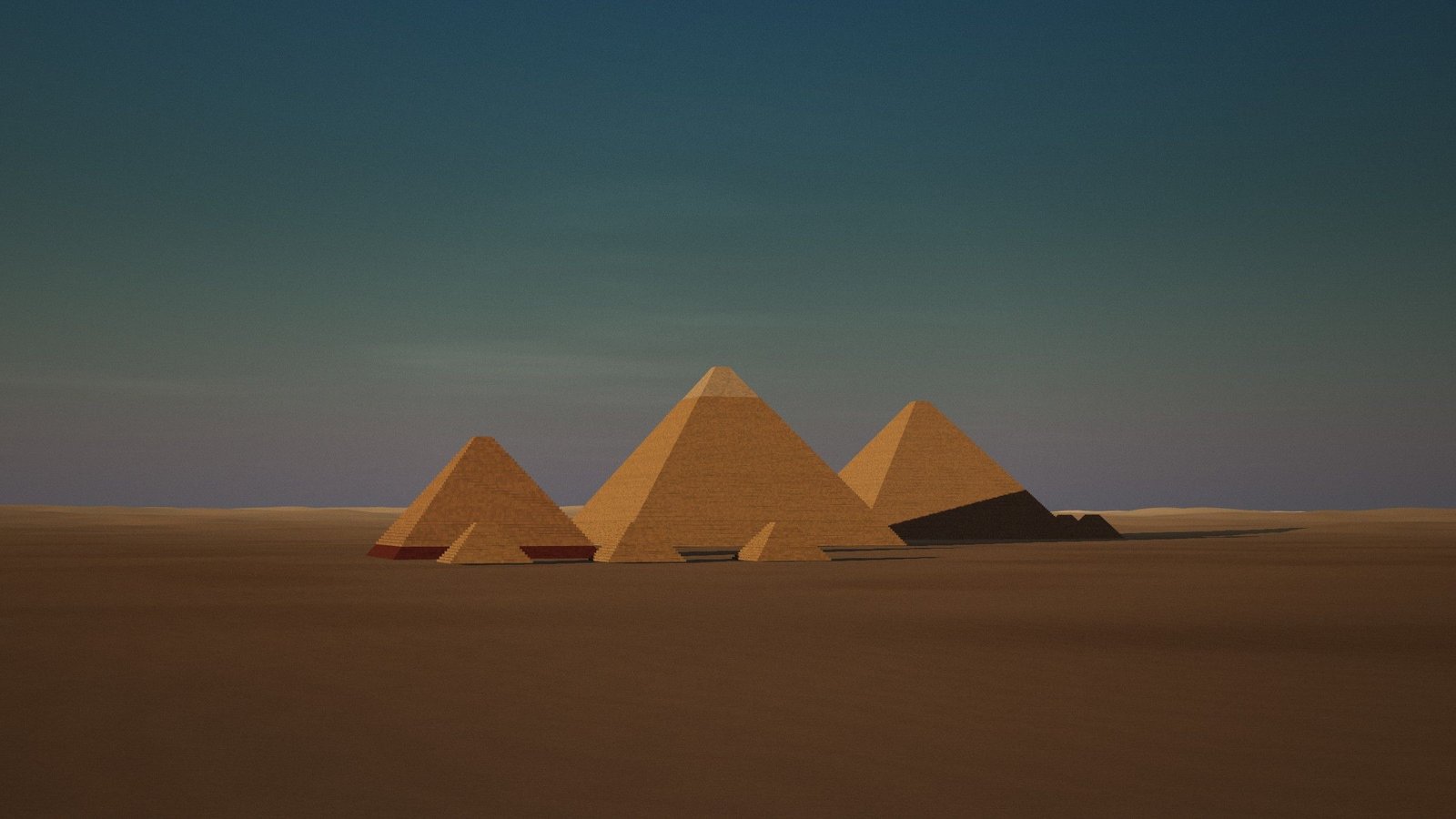
Reconstruction note: the three main pyramids are drawn to their published base sizes; their relative positions, and everything else on this plan (temples, causeways, boat pits, cemeteries, quarries, the Sphinx and the workers' town), are indicative placements by us and have not been checked against a survey plan. Dashed causeways are only partly traced. Select a pyramid or the Sphinx to open its page.
Damage and repair

The missing nose and beard

  • Well-supported evidence The nose was removed deliberately: marks of rods or chisels driven in at the bridge and below the nostril survive. It is already missing in Frederic Norden's drawings of 1737 (published 1755). Wikipedia, Great Sphinx of Giza
  • Plausible reconstruction The 15th-century historian al-Maqrizi attributes damage to the face to Muhammad Sa'im al-Dahr in 1378. Wikipedia, Great Sphinx of Giza; al-Maqrizi*
  • Speculative or weakly supported The popular story that Napoleon's soldiers shot off the nose in 1798 is contradicted by Norden's drawings, made decades before the French expedition. Wikipedia, Great Sphinx of Giza
  • Well-supported evidence Fragments of a stone beard were found in front of the Sphinx by Caviglia in 1817; some are in the British Museum. The reference work reports that the beard was most likely original, broke, and was reassembled at a later time, most likely during Thutmose IV's restoration; Stadelmann used its style in his argument for Khufu. Wikipedia, Great Sphinx of Giza
Three and a half thousand years of care

Restoration history

  1. c. 1400 BCEThutmose IV clears the sand, builds mudbrick walls around the enclosure, restores the body and sets up the Dream Stela between the paws. The earliest phase of limestone casing on the body probably dates to his reign. Hawass; D. Everett; Wikipedia, Great Sphinx of Giza
  2. 26th DynastySaite repairs to the tail and the nemes headdress. Hawass
  3. Roman periodProtective stones added to the paws and the sides of the body. Hawass
  4. 1378 CEAl-Maqrizi attributes damage to the face to the Sufi Muhammad Sa'im al-Dahr. Wikipedia, Great Sphinx of Giza; al-Maqrizi*
  5. 1817Giovanni Battista Caviglia excavates in front of the chest and finds fragments of the beard. Wikipedia, Great Sphinx of Giza
  6. 1925–1936Émile Baraize clears the Sphinx and repairs it, including cement work on the head. Hawass
  7. 1937Selim Hassan excavates the Sphinx and its surroundings. D. Everett
  8. 1955–1987The Egyptian Antiquities Organization repairs the body in 1955, 1977, 1979 and 1982–87. Part of a hind paw collapses in October 1981. Hawass
  9. 1979–1983The ARCE Sphinx Project, directed by Mark Lehner, maps the Sphinx in detail. D. Everett
  10. 1988–1998After a block falls from the southern shoulder in February 1988, a new project (January 1989 – December 1998) removes the cement of earlier repairs and lays new limestone. Hawass
Scholarly positions

Who carved it, and when?

Most specialists date the Sphinx to Khafre's reign. Other views are set out here with the strength of the evidence for each.

  • Well-supported evidencePhysical remains, inscriptions or measurements that archaeologists agree on.
  • Plausible reconstructionConsistent with the evidence and widely accepted, but not directly proven.
  • Active scholarly debateProposed by specialists; the evidence is partial or points in different directions.
  • Speculative or weakly supportedContradicted by, or lacking, archaeological evidence. Mentioned so readers can place it.

Carved for Khufu

Active scholarly debate

Rainer Stadelmann argued from the style of the headdress and the detached beard that the Sphinx represents Khufu, and that Khafre's causeway was built to respect a Sphinx already there.

Sources: Wikipedia, Great Sphinx of Giza; Stadelmann*

Carved for Djedefre

Active scholarly debate

In 2004 Vassil Dobrev (IFAO) announced evidence that Khufu's son Djedefre may have made it. This remains a minority view.

Sources: Wikipedia, Great Sphinx of Giza

Much older than the pyramids

Speculative or weakly supported

The geologist Robert Schoch argued that erosion of the enclosure walls required long periods of heavy rain, first dating the Sphinx to 5000 BCE or earlier and later to around 9700 BCE. Most archaeologists reject this. Critics attribute the erosion to salt crystallisation (haloclasty) in the soft Member II limestone, to run-off and floods, and note evidence of heavy rain into the Old Kingdom; no archaeological evidence of an earlier builder has been found.

Sources: Wikipedia, Sphinx water erosion hypothesis; Schoch*

The weathering debate Speculative or weakly supported

The walls of the Sphinx enclosure are deeply eroded into rounded profiles. The geologist Robert Schoch argued that only long periods of heavy rainfall could do this, which would place the carving thousands of years before Khafre. Critics attribute the erosion to salt crystallisation (haloclasty) in the soft layers of Member II, and to run-off and flooding, and point to evidence that heavy rain continued into the Old Kingdom. Wikipedia, Sphinx water erosion hypothesis; Schoch*

One argument for an older Sphinx compares it with the Old Kingdom tomb of Debehen, said to be cut in the same layers yet less weathered. AERA replies that the tomb lies about 418 m west-south-west of the Sphinx and some 27 m higher, in a different series of layers, so the difference reflects the rock and its setting, not age. The geologist Colin Reader accepted a role for rainfall run-off but argued only for a somewhat earlier date, in the late Predynastic or Early Dynastic period. No archaeological evidence of an earlier builder has been found. AERA; Wikipedia, Sphinx water erosion hypothesis; Wikipedia, Great Sphinx of Giza; Reader*

References and source notes

Reference works consulted

Encyclopedia articles read to check specific facts; they cite the primary literature listed with them, which was not itself read.

Standard references cited but not consulted

Recognised works named for context and further reading. They were not read when this page was checked, so no claim here rests on them alone. Marked * in inline citations.

Reconstruction assumptions

  • The rendered view of the Sphinx on this page is a schematic massing model built by us to the published length and height. The shapes of the head, paws and body are simplified, and no surface detail is modelled.
  • The profile diagram is schematic; only its overall length and height are to scale. The heights of the rock members are indicative.
  • On the plateau plan, the Sphinx, its enclosure and the nearby temples are indicative placements, not traced from a survey.
Location

On the map

Tap a marker for details, or zoom out to see the whole Nile valley.

Map showing the location of Great Sphinx of GizaMemphisThebesAbydosAmarnaHierakonpolisElephantineAvaris / Pi-RamessesTanisSaisBubastisMendesSebennytosHerakleopolisItjtawyBuhenSemnaKV34 · Thutmose IIIKV43 · Thutmose IVKV62 · TutankhamunKV17 · Seti IKV7 · Ramesses IIQV66 · Queen NefertariStep Pyramid of DjoserGiza PlateauGreat Pyramid of GizaGreat Sphinx of GizaKarnak Temple ComplexMortuary Temple of HatshepsutAbu Simbel TemplesMedinet Habu
Coastline and Nile: Natural Earth 1:10m (public domain). Modern features such as Lake Nasser are omitted. Site positions are approximate.